I write about the three topics that I am most passionate about; Sales, Marketing and Social Media. These topics are covered from my experiences in outside sales and marketing. My objective is to use my expertise to help business and the individual.
What You Don’t Think about when you Start in Outside Sales-Sales Logistics
Before you start selling, you need to do sales planning. This includes market research, understanding territory geography, and product knowledge and objection handling through sales training.
Here is what you don’t think of.
How long will your sales process take?
How long will each sales call last?
How long does it take to go from one appointment to another? Mapping can help, but you won’t know until you do it regularly. Knowing how often to call on prospects and customers to be top of mind, without irritating them, because everyone is different.
How cold calls on prospects will go.
Cold calls are a great way to hone your objection-handling skills and gain new business.
The emotional roller coaster of the highs of making the sale, mixed with the depths of being rejected.
The uncertainty of how much you will earn for your efforts.
If you are truly cut out for a career in Sales.
That you are not alone, even though you are in the field by yourself.
Where to find a bathroom you can use in relation to your location.
Dealing with the weather.
Sales can teach you a lot about business and enable you to earn a great living, but it is not for everyone. Everyone should try sales at least once in their career.
What surprised you when you started in Outside Sales?
I write about the three topics that I am most passionate about; Sales, Marketing and Social Media. These topics are covered from my experiences in outside sales and marketing. My objective is to use my expertise to help business and the individual.
When marketing and selling a product or service, it is important to ask two questions to understand your buyers.
1.What motivates people to buy a product or service?
2.How do people find a product or service to buy?
I surveyed my LinkedIn audience for answers.
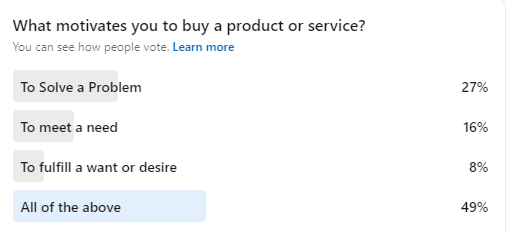
1. What motivates people to buy a product or service?
People buy a product or service to: solve a problem, meet a need, or fulfill a want or desire. 49% buy products and services to solve a problem, meet a need, or fulfill a desire. 27% wanted to solve a problem, 16 % want to meet a need, and 8% wanted to fulfill a want or desire.
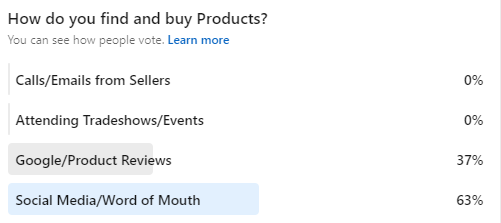
2. How do people find a product or service to buy?
People find and buy products or services through word of mouth, social media, online search, and,/or product reviews. Of those surveyed, none said they found or bought products from seller calls or emails. No one found or bought products attending trade shows or events; this can be because of the pandemic.
63 % found or bought products from social channels or word of mouth, and 37% found or bought products or services from online searches or product reviews.
These findings suggest businesses need to create products and services that are customer-centric. Businesses need a great reputation to survive in a competitive marketplace.
Answering these questions will help businesses develop, create and, position products and services customers want to buy.
Your approach will vary depending on your industry.
What motivates customers to buy your products and services?
How do your customers find products and services?
Join the conversation.
Posted 252 weeks ago
Sales, Marketing & Social Media Today
I write about the three topics that I am most passionate about; Sales, Marketing and Social Media. These topics are covered from my experiences in outside sales and marketing. My objective is to use my expertise to help business and the individual.
Insights from 2024 DMWF NA
Last week, I covered the Digital Marketing World Forum conference in New York. The conference was held at the Marriot Marquis in New York’s Times Square. The Digital Marketing World Forum or DMWF for short, covered a wide array of topics beyond just digital marketing, that covered AI, ecommerce, influencer marketing, and creativity just to name a few.
DMWF also had interesting service providers in the Digital Marketing space.
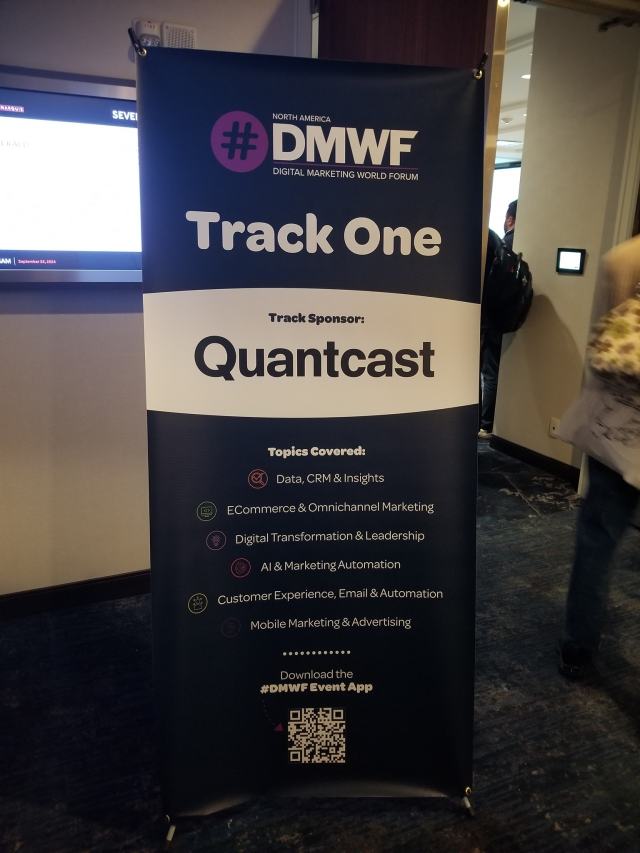
The conference was divided into two tracks. Track one consisted of topics that fell into the categories of: Covering Data, CRM & Insights // eCommerce & Omnichannel // AI & Marketing Automation // Digital Transformation & Leadership // Customer Experience, Email & Automation // Mobile Marketing & Advertising //.
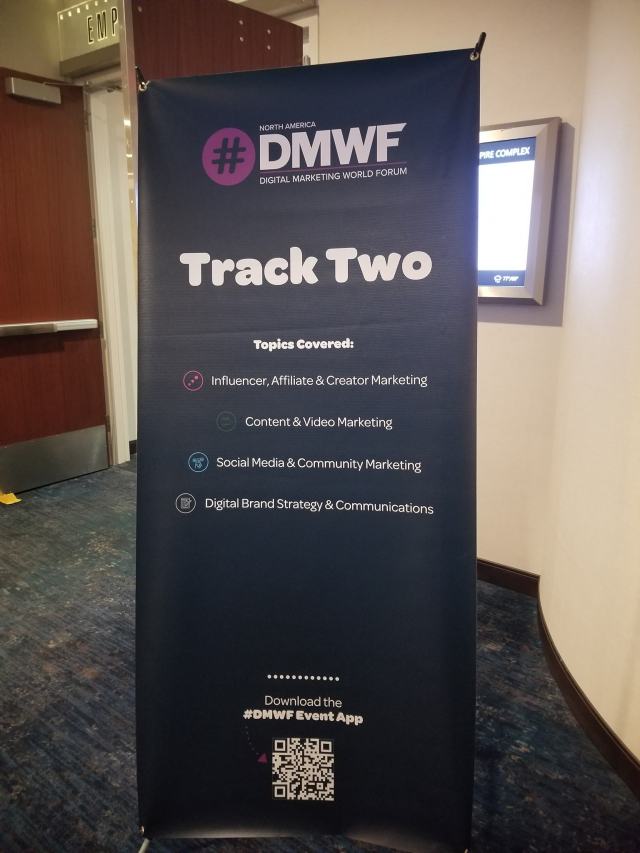
Track two consisted of topics that fell into the categories of: Influencer, Affiliate & Creator Marketing // Content & Video Marketing // Social Media & Community Marketing // Digital Brand Strategy & Communications //.
There were so many amazing discussions. The topics that I found the most interesting were Building a successful Full-Funnel Marketing Strategy, and How to navigate changing social platforms.
In the Building a successful Full-Funnel Marketing Strategy panel,
Shayna Macklin, Director, Social / Brand + Music Partnerships & Fractional CMO, Playboy Enterprises, Inc. & Rainbow Apparel Co
Carly Schrager, Head of Marketing Automation Engagements, North America, Bluprintx