Sales, Marketing & Social Media Today

I write about the three topics that I am most passionate about; Sales, Marketing and Social Media. These topics are covered from my experiences in outside sales and marketing. My objective is to use my expertise to help business and the individual.

The Rise of the Learning Pod: How COVID-19 Launched a New Industry

COVID-19 forced US schools to Teach remotely for the first time in history back in March 2020. Many Teachers were not prepared to deliver remote instruction. Parents complained that the quality of their child’s education has declined since remote instruction began. Schools used this remote learning model until the end of the school year. As Summer vacation ends, parents grapple with the issue of whether they want to send their children back to school.

Many school districts across the US such as those in California have opted to keep remote learning for the fall because COVID-19 has resurged. In areas where COVID-19 cases are down, school districts such as New York City have opted for blended learning models where students report to school on some days and learn from home for the rest. According to Common Sense Media, over 50 million public school students in kindergarten through 12th grade will be learning remotely from home this year.

While safety is a top priority, the job of a school is to educate students. Parents are not satisfied with the public education offerings that have been presented for the Fall 2020 school year. This dissatisfaction with public education has made many parents seek out educational alternatives beyond blended and remote learning. These alternatives include learning pods, and supplemental education services such as tutoring.

Learning Pods Versus Tutoring

Learning pods are small learning communities where students meet every day to get instruction from a Teacher. This is different than tutoring because tutors review and reteach material as opposed to presenting new concepts. Tutoring functions as an educational supplement.

Why Parents are opting for In-Person Learning Pods

Parents that opt to use learning pods are looking to gain an educational advantage for their children by recreating traditional schools in a small group setting. The benefits of learning pods are that student instructional and social-emotional needs are met.

The Downside and Risk of In-Person Learning Pods

While this might sound like the perfect fix to remote learning and blended learning it comes with risks. The risks are that students and teachers are still at risk to contract COVID-19.

Another drawback of in-person learning pods is finding space. To address the issues of space, parents are buying apartments and houses; transforming them into schoolhouses. Marie spent $2000 to transform her guest house into a classroom she ordered desks, a whiteboard, a 50-inch television to live stream zoom tutorials, and built a library complete with personalized pencil boxes and workbooks.

Another mother is spending $720 per week to have her preschool son tutored in french with two of his friends.

Amanda Uhry, the NYC-based founder of Manhattan Private School Advisors, states Pandemic in-person pods can cost parents up to $100,000.

Some NYC parents are spending up to $70,000 on elite pod teachers, plus $2,500-a-month on studio apartments to serve as makeshift classrooms, plus an additional $50,000 to keep their kids enrolled at their private schools.

Why Virtual Learning Pods are the best option

How can parents get the benefits of a learning pod at an affordable price? Parents can look to tutoring services that offer virtual learning pods. Virtual learning pods eliminate the need for physical space making them more affordable than in-person learning pods. Groups of parents can sign their children up together in a virtual learning pod to lower the cost even more.

Virtual learning pods take the benefits of traditional school and put it online. Students get the benefits of individualized attention and social interaction all of which are lacking in traditional remote learning. Parents can have peace of mind that knowing that their child will not contract COVID-19; something that pricey in-person learning pods can not guarantee.

How Education Companies Can Corner the Learning Pod Market

Companies that offer Teacher staffing, tutoring, and instructional materials to schools can seize the opportunity in the learning pod market because they are well established in their industry.

K-12 Education and learning companies that hire seasoned certified teachers as tutors and learning pod instructors will be able to do better than companies who hire non-certified or inexperienced Teachers. Why? The reason is that Teacher certification and experience will help companies overcome the credibility hurdle. For Education companies that offer virtual learning pods, the teachers and tutors would need to be skilled in distance learning and remote teaching.

Would you choose a learning pod over traditional instruction for your child?

Why or why not?

Join the conversation.
Posted 301 weeks ago

Sales, Marketing & Social Media Today

I write about the three topics that I am most passionate about; Sales, Marketing and Social Media. These topics are covered from my experiences in outside sales and marketing. My objective is to use my expertise to help business and the individual.

How to Create Content Customers Love

Creating content that engages customers is key. Another key element to creating customer-centered presentations and digital content is knowledge of buyer learning styles.

In other words, how do buyers learn best?

There are three learning styles, Visual, Auditory, and kinesthetic. 65 percent of learners are Visual but this is not everyone.

Survey Results

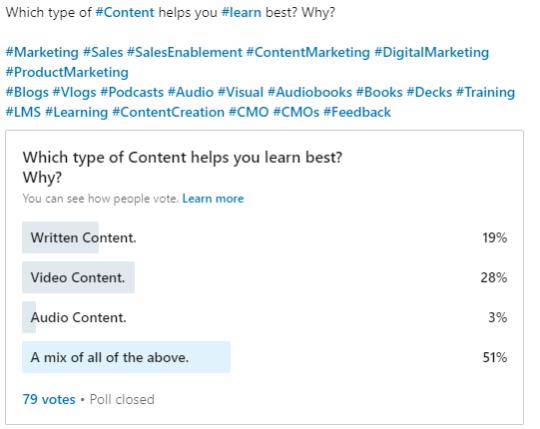
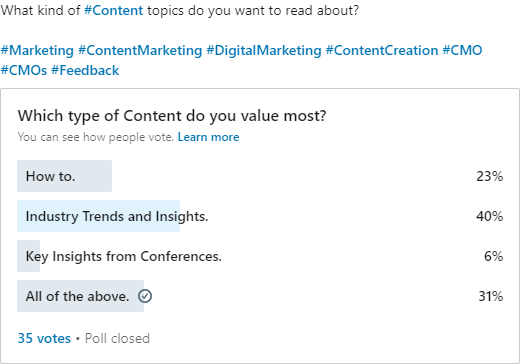
I surveyed my LinkedIn Audience to ask which types of content helps them to learn best and what type of content they value most.

As you can see, people learn best from a mix of written, video, audio, and content formats.

Of the types of content, people want to read, many want to read industry insights, how-to, insights from conferences, and a mix of all of the above.

Based on my findings, I would recommend that content be:

1.Created and repurposed in multiple formats

2.Content is about industry insights, how-to, and insights from conferences

The overall content strategy should be based on how your customers learn and the types and format of content based on their wants and needs.

Bonus Content

In the presentation below, I provide ideas and strategies to:

1.Collect information on your buyer’s learning style

2.Create presentations and content that will engage buyers with content that is optimized to their learning style making it more engaging**

3.Create differentiated presentations and content for all learners when buyer learning styles are unknown

** How to Customize Presentations & content to Buyer learning Styles **

from

Dan Galante

How do you learn best and which content format helps you most? Comment and share.

Posted 291 weeks ago

Sales, Marketing & Social Media Today

I write about the three topics that I am most passionate about; Sales, Marketing and Social Media. These topics are covered from my experiences in outside sales and marketing. My objective is to use my expertise to help business and the individual.

Trends in the US Auto Industry: Key Insights from the 2026 Auto Forum New York

I covered the Automotive Forum New York, the day before the New York International Auto Show. This event connects Automotive thought leaders with Manufacturers and Dealers. Attendees learned about trends and insights in the Automotive industry that focus on the dealer side of the business.

The auto forum started with an economist who analyzed the US Economy as a whole, followed by Thomas King, President, Data & Analytics Division, Chief Product Officer at JD Power, who analyzed the US auto industry, addressing the issue of disappearing EV Tax credits, a surge in lease returns that will reshape the inventory and demand planning. Thomas also addressed the issue of softening trade equity and the rise of subprime lending.

The State of the Automotive Industry

Thomas shared some interesting statistics and analysis. 

The total and retail vehicle Sales in the US for the first quarter are 3.7 million, down from a year ago on a retail basis are 2.9 million or 9% per week.

Vehicles were sold with larger discounts than the previous year at $3300 per unit. This has a negative impact on manufacturer profitability. In terms of new vehicle sales last year, the industry set an all-time high for money spent on vehicles. A great result, but a 7% decline. In terms of retail confidence on a per-unit basis, it was down $50 or $2. Retail volume was $6.1 million, a strong number that was down 10% from a year ago. 

The Automotive Industry is in good shape based on the data.

Prices are rising for vehicles. On average, a new Vehicle costs $46000, up $1000 from last year. Tariffs did not impact pricing because manufacturers absorbed them, as passing the cost to consumers would decrease sales. Manufacturers’ profitability remained stable. Manufacturers are planning to increase Sales and Market share. 

EVs are not driving Sales. With EV incentives gone, consumers are shifting to Gas Vehicles. Manufacturers are shifting back to more gas vehicles to meet consumer demand. 

In terms of lease payments, the average last year was $636 per month, and now it is $650, a modest increase for 36-month leases. With rising lease prices, dealers have a chance to convert lessees to new car buyers with 2.4 million leases ending this year. 13 percent of financed leasing sales are on loans that are 84 months or longer. Subprime lending can help increase sales if it is monitored and controlled. Subprime lending increased in the 1st quarter. 

Trade-ins were a selling point for dealers with the supply constraint back in 2022, with the average price being $29000. Vehicles traded in have lower equity because customers paid above sticker price back in 2022. 

Rising fuel prices will hurt new vehicle sales on leases because, as lease payments go up, the amount spent on gas decreases. However, people whose vehicle costs $46000 on average are less sensitive to rising gas prices. Car buyers who do not lease cars are less affected by rising gas prices. 2.8% percent of income is spent on fuel. 

Lower interest rates will make car buying and leasing less expensive. 

Consumers are on track to spend $623 million on new vehicles. Consumer spending predicted to be at an all-time high. Retailer profits are expected to be $25.4 billion, down from $28.9 million a year ago.

Volume is the same as last year, with the total number being 16.3 million and 13.6 million for retail.

Improving the Customer Experience at Auto Dealerships

A panel discussed how to improve the customer experience. Liza Borches and Rob Cochran shared their insights. The panel suggested being transparent to build customer trust, especially with pricing. Customers want to know how much a car will cost. Transparency also applies to service. Service is a profit center for dealers; this is an opportunity. Currently, there is a shortage of technicians. When customers see a price, they want to know if this is the final price. OEMs can improve the customer experience for customers by listening to and providing customers with what they want based on their needs. 

The panel also shared that dealer must use AI to automate their processes without losing a human touch. 

AI’s Impact on Car Buying

A panel AI in Auto discussed how AI is transforming vehicle buying and dealership operations. Jason Goldberg, GM, Global Client Development, The Trade Desk, Liam Golightley, Vice President, Customer Success, Podium, Jenni Newman, Editor-in-Chief, Cars.com, Brian Abrams, VP, Product Management, CDK, shared their insights. Brian Abrams moderated the panel. 

47 percent of consumers are using AI to date, and 64 percent of consumers use AI in their car shopping journey, but they want a human touch at the dealership, according to Cars.com. 70 percent of consumers are undecided on the make and model of a vehicle, according to Cars.com. AI is shortening the buying process by helping consumers become more informed faster. 67 percent of auto dealers are using AI, and their Business Development Center. AI is transforming the way consumers buy vehicles and how dealerships operate. 

What’s next for OEMs, Dealers, and Manufacturers?

Senator Bernie Moreno, a former car dealer, advised dealers and manufacturers on improving relationships with one another and the US Government in the One on One with Senator Bernie Moreno panel. John Fitzpatrick, CEO, Force Marketing, moderated the discussion. 

He shared about affordability in America. The Senator shared how the administration stopped California from submitting its own set of emissions standards. The goal is to have one set of emission standards to sell more cars abroad. He discussed removing the market distortion that EV mandates imposed on the auto market. EV mandates cost the industry 100 billion dollars. This is money that could have been spent on innovating cars and the industry as a whole. 

Bernie discussed allowing US automakers to collaborate on expensive new technologies to compete with Chinese Automakers. He described having Chinese cars here as a national security issue because they have cameras and would need to be connected to US infrastructure, a big risk.

The Senator discussed making more affordable cars, offering a $25000 car as Honda does. He also discussed service in the dealer franchise model. Dealers and Manufactures need to improve how they handle warranty issues for customers. 

It was a great event with many great panels. I learned a lot about the automotive industry.

I want to thank J.D. Power, NADA, and the New York International Auto Show for having me as their guest.

Posted 7 weeks ago